


History Rabbit Holes: One Line. One Search. One Forgotten Story.
Updated: Aug 2
How a January spirit communication transcript introduced me to a chapter of Charleston history I had never encountered before.
If you've read my first Rabbit Hole blog, you already know that I don't begin with conclusions.
I begin with curiosity.
Every spirit communication session I conduct is documented and transcribed. Rather than focusing on only the words that seem interesting, I work through the transcript systematically, one segment at a time. Every line deserves the same opportunity to be investigated.
Some research projects last a few minutes.
Others become full-blown rabbit holes.
On January 12, 2026, I turned my attention to one particular line recorded during a spirit communication session I had conducted next to Charleston's Old Exchange & Provost Dungeon on **January 2026.
The transcript read:
angry demon burned book dying shadow figure
Like every other line in the transcript, I treated it as a question rather than an answer.
Not proof.
Not evidence.
Not a conclusion.
Just another breadcrumb.
So I opened my laptop and started researching.
One Search
When I searched that line, something unexpected happened.
One archival result immediately stood apart.
It wasn't a vague reference to Charleston.
It wasn't an unrelated article from somewhere else in the country.
It described an event that had taken place right there—at the very location where I had recorded that spirit communication session.
Until that moment, I knew absolutely nothing about Charleston's 1835 Mail Crisis.
Nothing.
It wasn't a chapter of Charleston history I had previously studied.
I couldn't have told you the date.
I couldn't have told you what happened.
I couldn't have named the people involved.
In fact, I had no idea that the Old Exchange had served as Charleston's post office during that period.
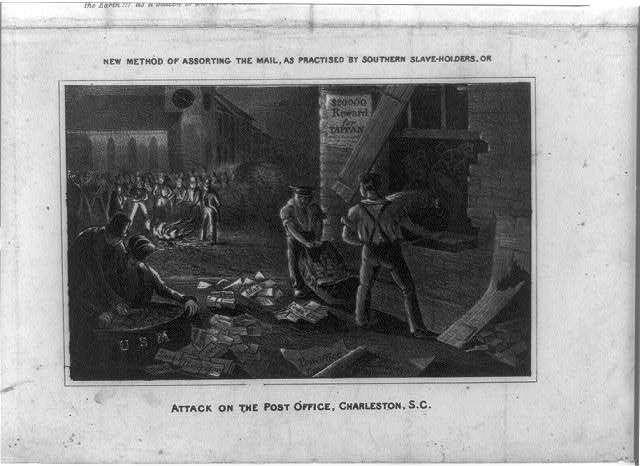
Yet there I was, reading an archival account describing how, in July 1835, abolitionist publications arriving through the United States mail became the center of one of the most dramatic public confrontations in Charleston's history.
The more I read, the more fascinated I became.
I learned that the events unfolded over two consecutive days—July 29 and July 30, 1835.
I learned that portions of those events occurred at the very site where I had conducted my investigation next to the Old Exchange & Provost Dungeon.
I learned that what I had expected to be a quick search had suddenly become something much larger.
Following the Breadcrumb
That evening wasn't about finding answers.
It was about discovering a story I never knew existed.
I spent the rest of the night learning the basic sequence of events surrounding July 29 and July 30, 1835.
Who was there?
What happened?
Why did it happen?
How did events unfold over those two days?
For the first time, I began piecing together the chronology of a forgotten chapter of Charleston's past.
At that point, my research was still in its infancy.
I hadn't yet explored the broader political climate.
I hadn't yet traced the deeper historical context.
I hadn't yet followed the countless rabbit holes that would eventually grow from this discovery months later.
That would all come later.
On January 12, I was simply captivated by one realization:
I had accidentally stumbled onto a remarkable story that had happened at the very place where I had gathered the spirit communication transcription data.
Why I Follow Breadcrumbs
People sometimes ask why I spend so much time researching.
This is why.
I don't know where a breadcrumb is going to lead before I start following it.
Sometimes it leads to a forgotten newspaper article.
Sometimes to an archaeological report.
Sometimes to a map.
Sometimes to a person whose story deserves to be remembered.
And sometimes...
it introduces me to an entire chapter of Charleston history that I didn't even know existed.
Whether that initial breadcrumb came from coincidence, intuition, a spirit communication session, or something else entirely isn't the point of this story.
The point is that it made me curious enough to ask a historical question I had never asked before.
The history that followed stands on its own.
The archives stand on their own.
The primary sources stand on their own.
The breadcrumb simply invited me to begin looking.
The Rabbit Hole Had Only Just Begun
By the end of that evening, I had learned enough about the events of July 29–30, 1835 to know I wanted to understand them more completely.
What I didn't realize at the time was that this was only the beginning.
The story of Charleston's Mail Crisis would become one of the deepest rabbit holes I'd ever explored.
Months later, I would intentionally return to the same location on the 191st anniversary of those events, conduct another investigation, and discover that the rabbit hole went far deeper than I had ever imagined.
But before we get there, we need to understand the story that first captured my attention.
Because every rabbit hole has a beginning.
Mine began with one line from a transcript...
...and two extraordinary days in July 1835 that I had somehow never heard before.
Next in the series: History Rabbit Holes - July 29–30, 1835: Charleston's Mail Crisis, Day by Day.


Comments