


Stede Bonnet vs. Pop Culture: Why the “Gentleman Pirate” Keeps Getting Rewritten (and Why It Works)
- History, Haunts, & Hahas!
- 3 minutes ago
- 6 min read

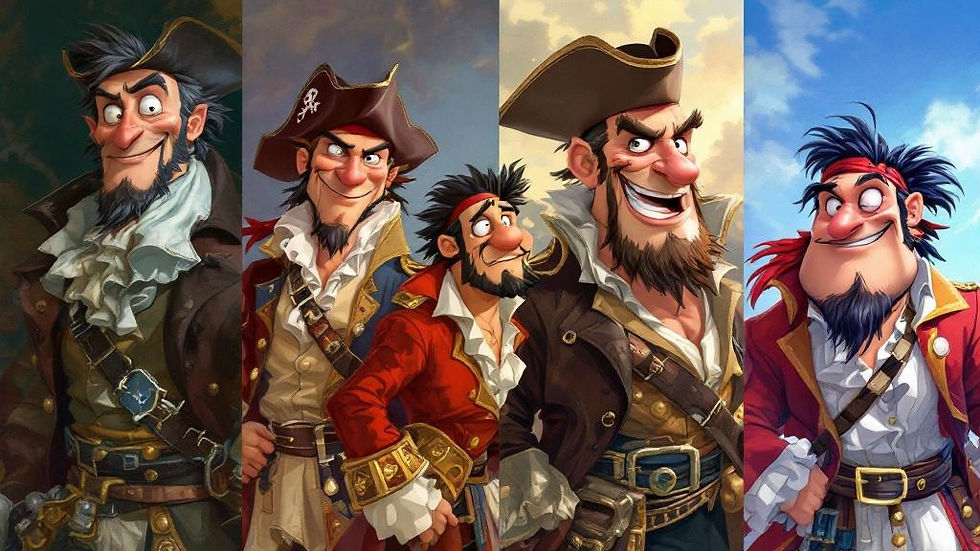
If you’ve met Stede Bonnet through Our Flag Means Death, you probably picture an anxious, linen-clad aristocrat playing dress-up with piracy—soft-hearted, romantic, and weirdly relatable.
If you meet him through the record, you get something thornier: a wealthy Barbadian landowner and militia officer who chose piracy in 1717, sailed under an infamous flag, partnered (at least temporarily) with Blackbeard, and was ultimately tried and hanged in Charles Town (Charleston), South Carolina in December 1718. (South Carolina Historical Society)
So why does modern storytelling keep reshaping him—sometimes into a lovable misfit, sometimes into a cautionary villain, sometimes into a cameo with a cool hat?
Because Bonnet is one of history’s most “adaptable” pirates: a ready-made character engine that lets writers explore identity, class, masculinity, companionship, queerness, comedy, and cruelty—depending on what a story needs.
The documented Stede Bonnet (the short, citation-forward version)
Here’s the core that most reputable summaries agree on:
Born in Barbados (1688, often given as Bridgetown). (Wikipedia)
A wealthy planter / landowner (and part of colonial power structures), with militia/justice-of-the-peace associations in common summaries. (South Carolina Historical Society)
In 1717, he outfitted a ship (often described as unusually “purchased/commissioned” rather than seized) and turned to piracy—earning the label “Gentleman Pirate.” (Wikipedia)
He linked up with Blackbeard (Edward Teach/Thatch) for a time; accounts generally frame Bonnet as inexperienced and, at points, sidelined. (Wikipedia)
After later captures and legal proceedings connected to South Carolina’s crackdown, he was hanged in Charles Town (Charleston) in December 1718. (South Carolina Historical Society)
Charleston-specific anchor: Charleston County Public Library’s write-up on the 1718 pirate executions explicitly ties Bonnet’s execution to White Point (the battery area). (Charleston County Public Library)
Why Bonnet gets rewritten so easily: 5 storytelling “hooks” built into his life
He’s an “inside outsider.” A rich, educated man stepping into a world that runs on seamanship, violence, and reputation.
He’s inherently theatrical. A land-based gentleman turning pirate practically begs for costuming, manners, and “fish out of water” comedy.
He has a famous foil. Blackbeard is a myth-magnet; pairing Bonnet with Teach gives storytellers instant tension and chemistry. (SlashFilm)
His motives are narratively “blank.” History records actions more than inner life—so writers fill the silence with psychology, romance, or satire.
He’s morally complicated. Modern scholarship and public history discussions also raise the issue of colonial wealth and slavery in Barbados—details adaptations may minimize or omit when aiming for a cuddly hero. (doinghistoryinpublic.org)
Our Flag Means Death: the romantic workplace comedy version of Bonnet
What it keeps from history
The core premise—wealthy gentleman becomes pirate—is straight from the headline facts. (Wikipedia)
The Bonnet/Teach partnership: historically documented as a real association, though the nature of it is debated and often described as pragmatic, strategic, or opportunistic rather than romantic. (SlashFilm)
What it transforms (and why)
Genre shift: The show deliberately reframes piracy into a rom-com/workplace ensemble, using Bonnet as a vehicle for chosen-family warmth, queer joy, and emotional vulnerability. (EW.com)
Relationship archetype: “Opposites attract”—refined, tender Stede vs. infamous, world-weary Blackbeard—becomes the emotional engine. Even mainstream press coverage emphasizes the romance as central to the series’ intent. (EW.com)
Ethical softening: Public-history critique notes that “gentleman” framing can erase the violence and exploitative systems that made someone like Bonnet possible in the first place (especially Barbados’ plantation economy). (doinghistoryinpublic.org)
Why this portrayal works: Bonnet becomes a symbol of reinvention—someone trying (clumsily) to step out of the role society wrote for him. Whether or not that matches the historical Bonnet’s inner life, it resonates with modern audiences.
Black Sails: Bonnet as a function of the pirate ecosystem
Black Sails (as a franchise) tends to treat pirates as political actors in a brutal economy—less whimsy, more consequence. When Bonnet shows up in that tonal universe, he’s usually used to illustrate one of two things:
“Not all pirates are equal.” Some are sailors first; some are opportunists; some are out of their depth.
Piracy as a system, not a costume. In a darker series, Bonnet can be deployed as a cautionary example: money and status don’t magically confer competence at sea.
Even pop-culture analysis pieces about the show lean into this angle—Bonnet as the “worst pirate ever” not because he’s silly, but because piracy is deadly serious in that story world. (Den of Geek)
Video games: Bonnet as “historical flavor” (and why games love him)
Assassin’s Creed IV: Black Flag
Games often use famous pirates as quest anchors—recognizable names that lend authenticity while the player’s story stays in control. Black Flag explicitly includes Bonnet among its historical figures. (Wikipedia)
Why he fits games so well: he’s a “gentleman pirate,” which signals intrigue + contradiction in one phrase. Writers can make him sympathetic, shady, or tragic without breaking the brand.
Sid Meier’s Pirates!
In Pirates!, historical pirates are often “boss encounters” or collectible legends. Bonnet appears as part of that ecosystem. (Sid Meier's Pirates! Wiki)
Why: he’s instantly legible to players as the aristocrat-gone-rogue archetype—and his name carries enough historical weight to feel “real” even when the game is gleefully anachronistic.
“Steven Bonnet” (Outlander) is not Stede Bonnet (but the name is doing the same work)
If you’re hearing “Bonnet” and thinking Outlander: that’s Stephen Bonnet, a fictional character (a pirate/smuggler/villain) in the Outlander universe, not Stede. (Outlander Wiki)
So why the near-match?
Because “Bonnet” has become a shorthand for pirate menace in modern storytelling—especially for audiences who vaguely associate the surname with the “gentleman pirate” legend. Commentary aimed at Outlander audiences even points out the name similarity. (Outlander North Carolina)
Archetype difference:
Stede (history/pop legend): identity crisis + class contradiction + “can a gentleman become a pirate?”
Stephen (Outlander): predatory opportunist + threat to protagonists + “the sea makes monsters.”
Same vibe-adjacent label, totally different narrative job.
Literature: the “Captain Charles Johnson” problem (and why it matters)
A lot of pirate “facts” people think are primary history trace back to 1724’s A General History of the Pyrates, attributed to “Captain Charles Johnson” (likely a pseudonym). It’s hugely influential, but it’s also widely discussed as a text that blends reportage, rumor, and literary invention—meaning it can shape Bonnet’s legend while muddying precision. (Wikipedia)
You can read the text itself via Project Gutenberg (useful for understanding the origin of many pirate tropes), but treat it like: period storytelling with receipts sometimes missing, not a clean court transcript. (Project Gutenberg)
So…who is Stede Bonnet “really”?
He’s two things at once:
A historically documented pirate whose story ends in Charleston—with specific local memory tied to the 1718 executions and White Point. (Charleston County Public Library)
A narrative mirror modern creators keep holding up to different themes:
Our Flag Means Death: reinvention, tenderness, queer romance, found family. (EW.com)
Black Sails: realism, violence, political economy, competence. (Den of Geek)
Video games: historical atmosphere + flexible character utility. (Wikipedia)
Outlander: name-echo as pirate-coded villainy—without being the historical figure. (Outlander Wiki)
The throughline isn’t “accuracy.” It’s what Bonnet symbolizes.
Charleston-tour-friendly closer (history-forward, hype-free)
If you’re walking Charleston with pirate history on your mind, Bonnet isn’t just a meme or a rom-com lead—he’s part of a documented 1718 crackdown that left a real mark on local memory. And that’s the sweet spot for storytelling: let pop culture bring people to the topic, then let Charleston’s records and institutions ground it.
FAQ
Did Stede Bonnet and Blackbeard actually have a romance?
The historical record supports an association/partnership, but modern articles discussing the show typically frame the romance as the series’ intentional reinterpretation rather than a settled historical claim. (SlashFilm)
Was Bonnet really executed at White Point in Charleston?
Charleston County Public Library’s historical piece on the 1718 pirate executions connects Bonnet’s execution to White Point. (Charleston County Public Library)
Is “Stephen Bonnet” from Outlander the same person?
No—Stephen Bonnet is a fictional character in the Outlander story world; the name is often noted as similar to and likely inspired by Stede Bonnet, but they’re not the same. (Outlander Wiki)


Comments